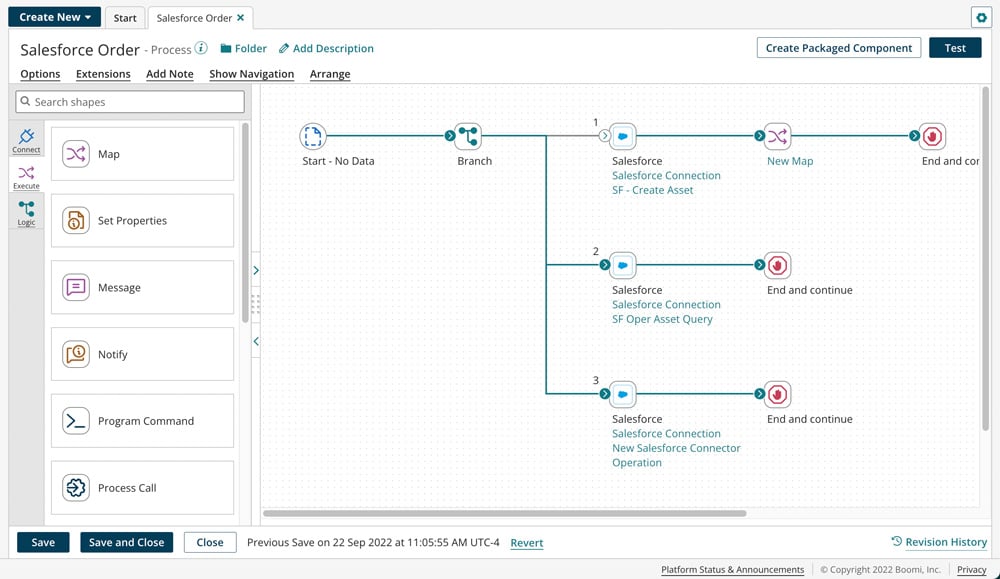
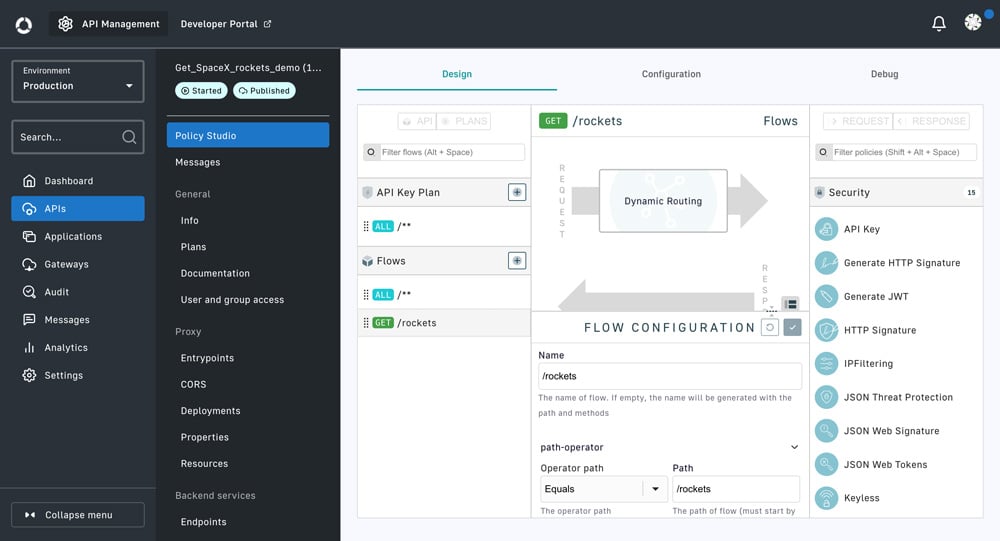
Companies evaluate MuleSoft alternatives for three main reasons: cost ($140K-$250K annual total ownership cost), complexity (3-6-month implementations requiring specialized engineers), and use case fit (MuleSoft excels at 10+ complex API projects but can be overkill for focused CRM-ERP integration needs).
Table of concepts:
This comparison examines three other integration platforms in terms of features, pricing, ease of use, connector ecosystems, and support models. MuleSoft dominates enterprise API-led architecture, but alternatives excel in faster deployment (Boomi), mid-market affordability (Celigo), and dedicated team delivery for CRM-ERP integration (Rapidi).
We'll compare deployment speed, total cost of ownership, connector libraries, learning curves, and which platform best fits specific use cases.
Comparison Table between MulesOFT, rapidi, boomi and celigo
| Factor |
MuleSoft |
Rapidi |
Boomi |
Celigo |
| Entry pricing |
$57K-$120K/year |
$4K-$8K/year |
$99/month PAYG |
~$10K/year |
| Enterprise pricing |
$140K-$250K+ total |
$16K-$34K/year |
$25K-$75K/year |
$15K-$25K/year |
| Setup time |
3-6 months |
4-6 weeks |
2-4 months |
4-8 weeks |
| Pre-built connectors |
1,000+ |
CRM-ERP specialist |
600+ |
300+ |
| API capabilities |
Full lifecycle |
REST API/SOAP/GraphQL |
Full iPaaS |
REST/SOAP/GraphQL |
| Ease of use (1-10) |
4/10 (developer-focused) |
9/10 (team delivers) |
6/10 (low-code) |
7/10 (business user) |
| Implementation model |
Buy platform + hire consultants |
Team delivers solution |
DIY or hire a partner |
DIY with docs |
| Support model |
Tiered (Gold/Platinum/Titanium) |
Included & personalized and a dedicated team |
Tiered (+25-35% extra) |
Bundled or tiered |
| Best for |
Enterprise 10+ projects |
CRM-ERP integration in particular with MS Dynamics/Salesforce, HubSpot, D365 Sales |
Mid-market iPaaS |
NetSuite/Salesforce |
Rapidi
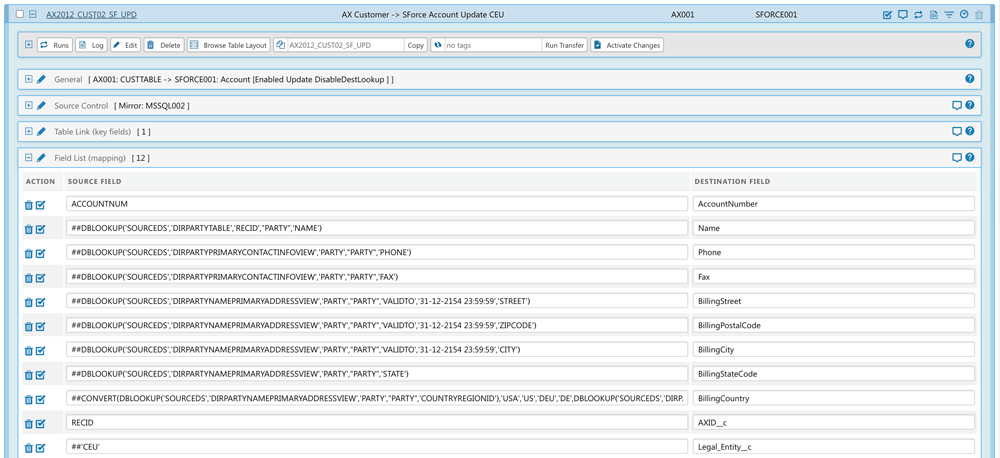
Image source: MyRapidi
Best for: CRM-ERP integration with dedicated team delivery, mid-market companies & larger organizations (50-1000 employees)
Rapidi is a cloud-managed integration platform specializing in CRM-ERP synchronization. Unlike DIY platforms, Rapidi provides a dedicated implementation team that delivers complete working solutions in 4-6 weeks with pre-built business process templates.
Strengths
- Dedicated team delivery: Team builds and delivers a complete solution (not software to learn yourself)
- Implementation included: No separate consultant fees (saves $60K-$100K vs. MuleSoft)
- Support included: Direct access to the team who built your integration (no tier upgrades)
- CRM-ERP specialist: 30+ years of experience with Salesforce-Dynamics, Salesforce-SAP, Salesforce-NetSuite
- Transparent pricing: Fixed monthly cost ($335-$2,800/month) with no quote surprises
- Fastest ROI: 2-3 months to break-even vs. 8-30 months for DIY platforms
- Pre-built processes: Quote-to-cash, customer master sync, and inventory management templates
- If you want to see how a specialist iPaaS platform is structured outside this comparison table, the Rapidi platform page gives the fuller view of its no-code architecture, connector model, and deployment approach
Limitations
- Specialized focus: Excels at CRM-ERP integrations, plus supports other systems & databases, not commonly used for 100+ diverse projects
- Not an iPaaS for developers: Not designed for coding your way to an integration.
Pricing
| Plan |
Monthly Cost |
Annual Cost |
What's Included |
| Entry |
$335/month |
$4,020/year |
Sync between two apps, support included |
| Business |
$675/month |
$8,100/year |
Customizable templates, multiple apps |
| Enterprise |
$1,350/month |
$16,200/year |
Dedicated team + complete solution |
| Unlimited |
$2,800/month |
$33,600/year |
High-performance custom solution |
All plans include: Implementation team, ongoing support, business process templates, and monitoring.
Integration Ecosystem
CRM Systems: Salesforce, Microsoft Dynamics 365 CRM Sales, HubSpot CRM
ERP Systems: Microsoft Dynamics 365 (Business Central, Finance, Finance & Operations, NAV, GP, AX), SAP (Business One, ECC, S/4HANA), NetSuite, Oracle ERP
Other Systems & Databases: Workday, Dayforce, BigQuery, Storyblok, etc.
Pre-configured processes:
- Quote-to-Cash (CRM opportunity → ERP order → invoice)
- Customer Master Synchronization (bi-directional with conflict resolution)
- Inventory Management (real-time ERP → CRM updates)
- Order-to-Invoice workflows
Who Should Use It
Mid-market companies (50-500 employees) but also caters for larger organizations (500+ employees) needing CRM-ERP integration, an IT or Operations Team at a company looking for a cost-effective, complete solution that runs in the background doing its sync job, timelines under 6 weeks, and a preference for team delivery over DIY learning, however, as Rapidi is easy to use and set up, the company can easily learn how to setup and work with their integration, to maintain it themselves moving forward.
Ease of Use: MuleSoft vs Boomi vs Celigo vs Rapidi
Easiest: Rapidi (9/10) - Dedicated team handles all configuration. Your team only defines requirements and tests. No-code platform, so no coding or learning required.
Very Easy: Celigo (7/10) - Visual flow-builder designed for business users. Comprehensive docs and training. Still requires 200-400 hours internal time.
Moderate: Boomi (6/10) - Low-code interface is more straightforward than MuleSoft, but still requires 2-4 months to become proficient. Technical analysts succeed.
Most Complex: MuleSoft (4/10) - Requires MuleSoft-certified engineers with Java/API expertise. It is powerful but has a steep learning curve.
Example: Connecting Salesforce to ERP for order sync
- MuleSoft: 6-8 weeks (developer builds custom API orchestration)
- Boomi: 4-6 weeks (analyst configures low-code process)
- Celigo: 3-4 weeks (business user builds flow with templates)
- Rapidi: 4-6 weeks (team delivers complete working solution)
Pricing Comparison: Total Cost of Ownership
Scenario: 200-person mid-market company, CRM-ERP integration, Year 1
Savings vs. MuleSoft:
- Boomi: $50K-$210K
- Celigo: $80K-$220K
- Rapidi: $124K-$242K (largest savings)
Connector Library: Which Has the Most?
Winner: MuleSoft (1,000+ connectors) - Most comprehensive pre-built library covering enterprise systems (SAP, Oracle, Salesforce, Microsoft, ServiceNow, Workday), custom connectors via SDK, and Anypoint Exchange for community templates.
Runner-up: Boomi (600+ connectors) - Strong enterprise coverage with good EDI/B2B protocols and a growing marketplace.
Specialized: Celigo (300+ connectors) - Focused quality over quantity with deep NetSuite/Salesforce expertise.
Specialist: Rapidi (CRM-ERP focused) - Not connector count focused, but specializes in major CRM-ERP combinations - especially on Salesforce, HubSpot, Dynamics 365 Sales with Dynamics 365 ERP - with 30+ years of domain expertise.
Verdict: If you need 20+ different system connections, choose MuleSoft or Boomi. If you need 1-3 CRM-ERP integrations done right, the number of connectors is less important than delivering quality solutions that work, then choose Rapidi.
Setup Time: Getting to First Integration
Fastest: Rapidi (4-6 weeks to a working solution)
- Week 1: Requirements gathering with a dedicated team
- Weeks 2-3: Team configures integration
- Week 4: Testing and refinement
- Weeks 5-6: UAT and go-live
- Your team's time investment: ~20 hours total
Fast: Celigo (4-8 weeks DIY)
- Week 1-2: Platform training
- Week 3-5: Build flows with templates
- Week 6-7: Testing and debugging
- Week 8: Production deployment
- Your team's time investment: 200-300 hours
Moderate: Boomi (2-4 months)
- Month 1: Learning platform and architecture
- Month 2-3: Build and test processes
- Month 4: Deploy and stabilize
- Your team's time investment: 300-400 hours
- Month 1-2: Hire consultants, define architecture
- Month 3-4: Build API layer and integrations
- Month 5-6: Testing, refinement, deployment
- Total cost: $60K-$100K in consultant fees
| Need |
Best Choice |
Why |
| Microsoft Dynamics/Salesforce Focus |
Rapidi |
Deep specialization, complete business processes via the pre-built templates, 30+ years of Data Integration & Replication expertise |
| Enterprise-scale workflows (10+ projects) |
MuleSoft |
1,000+ connectors, full API lifecycle, proven at scale |
| Fast time-to-value (under 6 weeks) |
Rapidi |
Team delivers vs. DIY, no learning curve |
| NetSuite/Salesforce focus |
Celigo |
Deep specialization, pre-built templates |
| Cost-effective CRM-ERP solution |
Rapidi |
$8K-$40K vs. $140K-$250K, 5-10x savings |
| API-first architecture |
MuleSoft |
Full API management, monetization, and governance |
| EDI/B2B at scale |
Boomi |
Integrated B2B/EDI, strong partner network |
| Small IT team (1-5 people) |
Rapidi |
Team delivery, no internal resource drain |
| Mid-market iPaaS (100-500 employees) |
Boomi |
Balanced cost/capabilities, pay-as-you-go option |
| Self-service with strong docs |
Celigo |
Best documentation, business user-friendly |
| Budget under $20K/year |
Rapidi |
Entry at $4K/year, all-inclusive |
Use Case Scenarios
Business Context: A 300-person manufacturing company needs to sync opportunities, orders, invoices, and customer data between Salesforce (CRM) and Dynamics 365 Business Central (ERP).
Winner for this scenario: Rapidi - Purpose-built for Salesforce-Dynamics, HubSpot-Dynamics but can be adapted to your specific needs, 5-10x cost savings, fastest ROI (3 months vs. 12-30 months).
Scenario 2: Building Custom APIs for Mobile App
Business Context: SaaS company needs to create APIs exposing data from 5 internal systems to a mobile app.
Winner for this scenario: MuleSoft - Purpose-built for API-led architecture with full lifecycle management and governance.
Scenario 3: Real-Time Inventory Sync (ERP → Multiple Channels)
Business Context: Retail company with multiple ERPs needs real-time inventory sync to Shopify, Amazon, and in-store POS systems.
Celigo - NetSuite specialization, ecommerce focus, pre-built retail templates at mid-market pricing.
Summary & Recommendations
Quick Recap
MuleSoft: Most powerful for complex API-led architecture across 10+ projects. Enterprise governance and complete lifecycle management. Highest cost ($140K-$250K year 1) and longest implementation (3-6 months).
Rapidi: Fastest delivery (4-6 weeks) with a dedicated team for CRM-ERP or Retail integration. Lowest cost ($8K-$40 year 1) with all-inclusive pricing for the solution.
Boomi: Balanced mid-market iPaaS with pay-as-you-go flexibility. Good for 5-10 integration projects. EDI/B2B strength. Moderate cost ($40K-$90K year 1) and timeline (2-4 months).
Celigo: NetSuite/Salesforce specialist with business-user-friendly interface. Strong e-commerce focus. Self-service approach requires internal time. Cost-effective ($30K-$60K year 1).
Choose MuleSoft if...
- You need 100+ complex integration projects
- You have a dedicated integration team with Java developers
- Budget exceeds $100K annually
- You need API monetization and governance
- You require complex API orchestration and lifecycle management
MuleSoft is overkill if you need 1-3 integrations, have a small to mid-size IT team, or have a budget under $100K.
Choose Boomi if...
- You need EDI/B2B capabilities at scale
- You're planning 5-10 integration projects
- You have technical analysts who enjoy learning platforms
- You want pay-as-you-go flexibility before annual commitment
-
- You prefer low-code over pure DIY
Boomi is overkill if you only need 1-3 CRM-ERP integrations, or lack technical resources.
Choose Celigo if...
- NetSuite is your ERP system
- You have technical business users who prefer DIY
- You need 3-8 integrations across SaaS applications
- Self-service with strong documentation matches your culture
- You operate in e-commerce/retail with Shopify/Amazon
- You want flat-rate pricing to avoid cost surprises
Celigo is overkill if: You're not NetSuite-centric or need less than 3 integrations.
Choose Rapidi if...
- You need CRM-ERP integration (e.g., Salesforce-Dynamics, HubSpot-Dynamics, or Dynamics ERP and Sales).
- Looking for a cost-effective and working solution that runs in the background while you concentrate on your core business
- Timeline is under 6 weeks
- You need both cloud and on-premises deployment
- You have legacy Dynamics Versions that need integration - Rapidi supports them all
- You want the team to deliver a complete solution vs. being stuck with an iPaaS where you need to learn everything yourself
- You value direct support from the team who built your integration
Rapidi is the obvious choice if you match 3+ of these criteria for CRM-ERP integration needs.
Get Started
For CRM-ERP integration, Rapidi delivers the fastest ROI, the lowest total cost, and a zero learning curve.
What you get with Rapidi:
- Working solution delivered in 4-6 weeks
- All implementation costs included (saves $60K-$100K)
- Direct support from your implementation team
- Transparent pricing: $335-$2,800/month
- 30+ years CRM-ERP specialization
Total savings: $100K-$210K in year 1 vs. MuleSoft
Faster ROI: Month 3 vs. Month 30
Updated July 2026
Frequently Asked Questions (FAQ)
Why would I consider an alternative to MuleSoft?
Cost: As highlighted in the RAPIDI article, MuleSoft’s annual total cost ($140K–$250K+) is much higher than alternatives like RAPIDI, Boomi, or Celigo.
Complexity: MuleSoft implementations often require 3–6 months and specialized engineers, while RAPIDI delivers working solutions in 4–6 weeks with a dedicated team.
Use Case Fit: MuleSoft is best for large-scale, API-led projects. If you need focused CRM-ERP integration, RAPIDI offers a purpose-built, cost-effective solution.
Can I replace MuleSoft with a simpler integration solution?
Yes. For CRM-ERP integration, RAPIDI delivers pre-built templates and managed onboarding, making it much easier and faster than MuleSoft’s DIY approach. For broader API management, platforms like Boomi and Celigo are also considered.
What are the top alternatives to MuleSoft discussed in the article?
RAPIDI: Best for CRM-ERP integrations, fast implementation, and all-inclusive support.
Boomi: Good for cloud-first, mid-market companies needing flexibility and EDI/B2B at scale.
Celigo: Ideal for NetSuite-centric businesses and SaaS/ecommerce automation.
Is it hard to migrate from MuleSoft to another platform?
Migration complexity depends on your use case. RAPIDI’s team-driven approach simplifies migration for CRM-ERP scenarios. For broader, multi-system migrations, careful planning is still needed, as noted in the article.
Are MuleSoft skills (like DataWeave) transferable?
Not directly. MuleSoft uses proprietary tech, while RAPIDI and other alternatives focus on no-code or widely-used tools, reducing the learning curve.
How do costs compare between MuleSoft and its alternatives?
RAPIDI: $8K–$40K/year, fast ROI (3 months).
Boomi: $40K–$90K/year, 2–4 months setup.
Celigo: $10K–$25K/year, 4–8 weeks setup.
MuleSoft: $140K–$250K+ year 1, 3–6 months setup, plus extra for consultants.
What features should I look for in a MuleSoft alternative?
Pre-built templates for your use case (CRM-ERP, ecommerce, etc.)
Fast deployment and low learning curve
Transparent pricing
Dedicated support or managed onboarding (like RAPIDI)
When is MuleSoft the right choice?
If you are a large enterprise with 10+ complex integration projects, need advanced API governance, and have the budget and in-house expertise, MuleSoft may be the best fit.
When is RAPIDI the right choice?
If you need CRM-ERP integration, want a dedicated team, need a quick go-live, and value transparent, all-inclusive pricing, RAPIDI is the clear winner (as shown in the article’s use case scenarios).