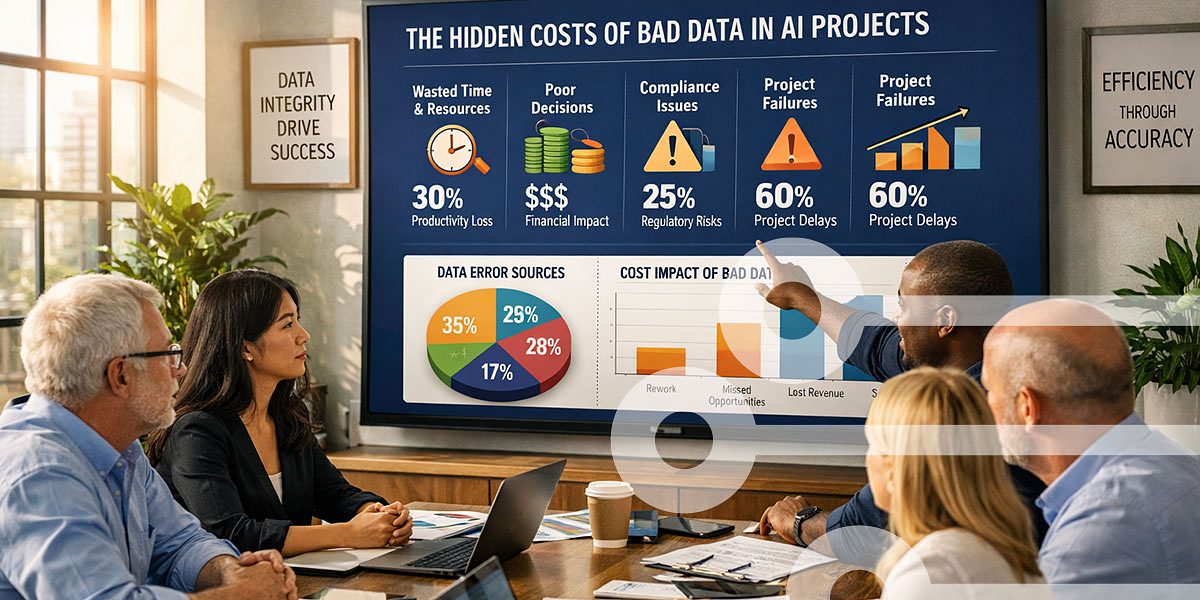
The Hidden Cost of Bad Data in an AI World
Most AI projects fail not because the AI is bad, but because the data feeding it is broken. Without clean, connected data between CRM and ERP systems, AI amplifies errors instead of fixing them.
Table of concepts:
- Why Bad Data is the #1 threat to AI ROI
- What bad data between CRM and ERP looks like
- How AI amplifies data problems
- Real-World costs of disconnected data
- How to Fix It: Simple, Proven Steps
- What AI Can and Cannot Do
- AI-Ready Data Checklist and 5 Integration Patterns Guide
Why Bad Data is the #1 Threat to AI ROI
Investing in AI promises smarter decisions, faster processes, and better business outcomes, but research tells a different story: MIT found that 95% of enterprise AI projects deliver zero measurable return, and IBM estimates poor data quality costs companies $12.9 million per year.
The reason? Most AI projects fail not because AI is flawed, but because the data feeding AI is broken.
In our webinar on March 18, Beate Haunstrup Thomsen, co-founder of Rapidi, and Deepak Hooda, FD/CFO at The CFO Centre UK, explored the hidden costs of bad data, real-world scenarios, and the honest capabilities of AI in data integration.
What Bad Data Between CRM and ERP Looks Like
Disconnected systems create real business risks:
- Outdated customer information: A Salesforce record has the wrong billing address in Dynamics. AI-generated invoices go to the wrong place.
- Mismatched pricing: Product prices updated in ERP but not CRM result in AI-powered quotes with incorrect numbers.
- Duplicate records: Revenue forecasting double-counts customers or opportunities.
-
Poor data governance: No controls on data entry or process errors allow mistakes to propagate unnoticed.
These small issues may seem minor, but AI amplifies them, creating faster, bigger, and costlier mistakes.
How AI Amplifies Data Problems
AI tools like Copilot, Einstein, and other analytics platforms assume your data is clean and consistent.
If CRM and ERP systems aren’t in sync:
- AI builds models on incomplete or outdated information.
- Manual error-checking disappears; AI speeds up both correct and incorrect processes.
- Decisions come out faster but not more accurate.
Data flows in → AI processes → Decisions come out.
If step one is broken, everything downstream is flawed.
Real-World Costs of Disconnected Data
- Manufacturing: AI demand forecasting trained on ERP data 24–48 hours behind leads to 6–8% excess inventory costs.
- Distribution: 23% of customer records mismatched; AI route optimization increases delivery costs and complaints.
- Professional Services: AI revenue forecasting based on inaccurate CRM pipeline data results in quarterly forecasts off by 15%, eroding CFO confidence.
How to Fix It: Simple, Proven Steps
You don’t need to replace your systems. You need them to talk to each other reliably.
Focus on:
- Real-time synchronization between CRM and ERP
- Consistent field mapping across platforms
- Error handling that prevents bad data from reaching AI
Rapidi has been doing this for 30 years, connecting Dynamics and Salesforce to help companies ensure AI investments pay off.
What AI Can and Cannot Do
AI helps with:
- Error detection and explanation (quickly identifies issues)
- Field mapping suggestions (reduces setup time)
- Anomaly detection (monitors unusual data patterns)
AI cannot replace:
- Business logic decisions specific to your company
- Complex data transformations between systems
- Understanding highly customized setups
“AI is a tool, not a replacement for integration expertise. The best results come when AI accelerates skilled people, not replaces them.” Beate Thomsen
Watch the Webinar Recording
Learn how to stop AI from scaling your data problems. Our 30-minute webinar covers:
- Hard numbers on the cost of bad data
- Three real scenarios where disconnected systems caused errors
- What AI is already good at in data integration
- What AI still cannot do
- Free resources: AI-Ready Data Checklist and 5 Integration Patterns Guide
What is considered “bad data” between CRM and ERP systems?
Bad data includes mismatched customer records, outdated billing or shipping addresses, duplicate records, inconsistent product pricing, and weak data governance that allows errors to propagate unchecked.
What makes RAPIDI different from traditional integration solutions?
Unlike custom-built integrations that require developers and long implementation cycles, RAPIDI offers a no-code platform designed specifically for business users. That means faster setup, lower costs, and no dependency on IT for day-to-day management.In addition, RAPIDI provides dedicated in-house support. You’re not left managing integrations alone — their experts help with setup, optimization, and ongoing assistance to ensure your integrations run smoothly as your business evolves.
What ROI can we expect from using RAPIDI?
While results vary, businesses typically see ROI through reduced manual work, faster reporting, improved decision-making, and lower dependency on external consultants.
How does AI amplify data problems?
AI assumes your data is clean and connected. If CRM and ERP systems are out of sync, AI builds models on incomplete information, speeding up decision-making, but also spreading errors faster than manual processes would.
What are the real business costs of bad data in an AI context?
Disconnected data can result in excess inventory costs, higher delivery costs, customer complaints, inaccurate revenue forecasting, and ultimately loss of trust from leadership teams.
Can AI fix data integration issues on its own?
No. AI can help with error detection, field mapping suggestions, and anomaly detection. However, it can not replace human expertise in business logic, complex transformations, or company-specific system setups.