
How can you reduce data integration costs? 5 practical tips
You can reduce data integration costs by improving data quality, limiting unnecessary customizations, choosing an integration approach that can adapt to future changes, designing your integration architecture carefully, and following proven integration best practices.
Some data integration projects can feel like overwhelming mountain ascensions. Whether they are small straight-forward integrations or complex, multi-site or international projects, it can feel like you will never reach the top. This is especially the case when it comes to costs.
Large scale implementations can easily take up to hundreds of hours, and the cost of your project can easily get out of control. With a simple, dedicated step by step approach you can avoid both the unnecessary delays and extra costs.
In this article:
What are 5 ways to reduce data integration costs?
With the rise of business intelligence, big data, machine learning or artificial intelligence, companies worldwide have been collecting larger amounts of data everyday.
When collected, this data is stored in various systems, data warehouses or data lakes. However, without an integrated environment, these data sets have little value. Without data integration, it is impossible to have one unified view of these different types of data. Data visualization becomes impossible.
Data integration has become a must for companies that want to take advantage of the data they collect. Despite the numerous data integration tools available on the market, moving data from source system to other systems is not necessarily a walk in the park.
When the difficulty to integrate data increases, so does the cost of data integration. Controlling data integration costs is possible if you follow 5 simple tips.
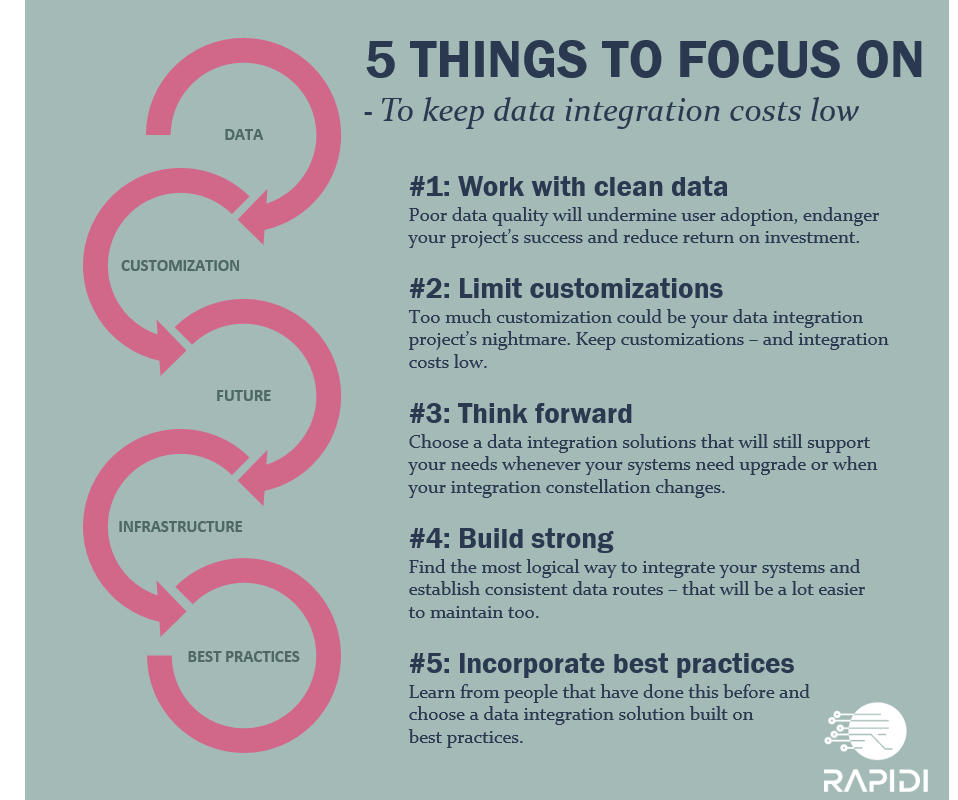
#1:Work with clean data
How does data quality affect integration costs?
Any data integration job can be compromised by poor data quality. If you feed your systems with poor quality data, you are not very likely to improve customer service or increase sales. While it is important to consolidate your data, it is just as crucial to make sure you can use the data in your integrated systems.
If the systems you wish to integrate both contain old, inaccurate or outdated data, you will not reap the benefits of the integration. Data cleaning (or data cleansing) is usually considered a long and painful process.
Data integration projects without a company-wide focus on data quality before, during and after the data integration implementation project inevitably fail.
Good data quality will ensure user-adoption and consequently the success of your data integration project. When users are given poor data quality, they start to distrust the data in the system and go back to old, unproductive processes.
The best data integration projects always have a dedicated data quality champion.
#2: Limit customizations - whenever possible
Why do customizations increase data integration costs?
Today, many systems and applications come out-of-the-box with role-tailored functionality. Despite this availability of standard features, most implementation projects include extra customizations and development efforts.
Customizations are usually made to support enterprise-, division- or user-specific working processes and habits. What might seem like a good idea in the beginning of a project can result in hundreds of custom modules or features.
This is when it becomes a data integration project nightmare. The more customizations have been done to your systems, the higher the risk to see your data integration project go over budget.
If you already have many customizations in the systems you wish to integrate (for example ERP or CRM system), you need to select a solution like RapidiOnline that can still easily integrate your solutions, regardless of the changes made.
#3: Build for the future
How can you future-proof your data integration?
Many ERP or CRM vendors have developed a one-off integration between systems for their customers. Some companies have even done it for themselves.
In-house development of a system integration might sound as a good idea in the beginning. You have the best understanding of the company’s processes and data models. However tempting this might sound, it can prove to be a mistake in the long run.
Such in-house data integration solutions are rarely developed with a full long-term future consideration. What will happen when the integrated systems get upgraded? What if you wish to extend the use of your integration tool and integrate with other systems?
When you choose your data integration solution, always make sure that it is future proof. Make sure it can still be used when the integration constellation changes. Home-made or custom-made interfaces generally require development, which makes upgrades and maintenance less flexible and more expensive.
#4: Build your data integration architecture carefully
How does integration architecture affect costs?
A company can easily have a need for up to 10-20 integrations between different systems. What is the most logical way to make these systems synchronize? The answer is not necessarily obvious and you must carefully design your infrastructure and data integration architecture.
When you integrate systems you have to differentiate primary systems from secondary systems. Primary systems are operational systems which carry business processes. Secondary systems are feeding information into the primary systems.
You can have primary data integrations between several primary systems to support business process automations. This removes double data entries and secures consistency and transparency across the operational systems.
Integrations to the secondary systems then feed data into the primary operational systems. This way, you establish consistent data routes and it is a lot easier to maintain consistent data.
This way, your system integration architecture will also be a lot easier – and cheaper - to maintain compared to a “spidernet” architecture prone to have multiple and redundant data channels between the systems.
#5: Incorporate best practices
What data integration best practices can help reduce costs?
Any data integration process should be based on best practices. The first data integration platform was not built yesterday. If you look long enough, you should be able to learn from what other people have done before you.
Even better, you are likely to find a data integration solution that can bring data integration best practices into your system integration project.
Some data integration solution providers like Rapidi A/S offer features based on best practices. RapidiOnline is a cloud integration system that comes out of the box with pre-configured templates allowing you to quickly integrate various systems.
The RapidiOnline pre-configured templates have been mapped based on the most commonly used fields from our past experience and best practices. However, you can easily add a customized table or field to your integration within minutes. Choosing such a system you can easily save both time and money.
Following these few easy tips should allow you to get the best start with your system integration project.
Looking for a more predictable way to manage your integration costs? Take a look at Rapidi’s pricing and integration options to find the approach that fits your business.

FREQUENTLY ASKED QUESTIONS
How much does data integration cost?
How can you reduce data integration costs?Working with clean data, limiting unnecessary customizations, planning for future changes, designing the right integration architecture, and following integration best practices can help keep costs under control.
Does Rapidi require custom coding?Rapidi is designed as a no-code data integration platform, allowing integrations to be configured and managed without traditional custom development. This can reduce reliance on programming resources for implementation and ongoing changes.
How can Rapidi help reduce data integration costs?Rapidi provides pre-configured templates and reusable configurations for common CRM and ERP integration scenarios, reducing the need to build every integration from scratch. This can help reduce implementation effort and simplify ongoing maintenance.
What are the hidden costs of poor data quality?Poor data quality can lead to inaccurate reporting, inefficient processes, duplicated work, integration issues, and unreliable AI outputs. Over time, these problems can increase operational costs and make it harder for teams to trust and use their data effectively.